
CAPCJ 2027 ACJCP Winnipeg
CAPCJ 2027 ACJCP

Save the Date - Réservez la date
Click the "Join" button above to RSVP. Cliquez sur le bouton "Join" ci-dessus pour confirmer votre présence.
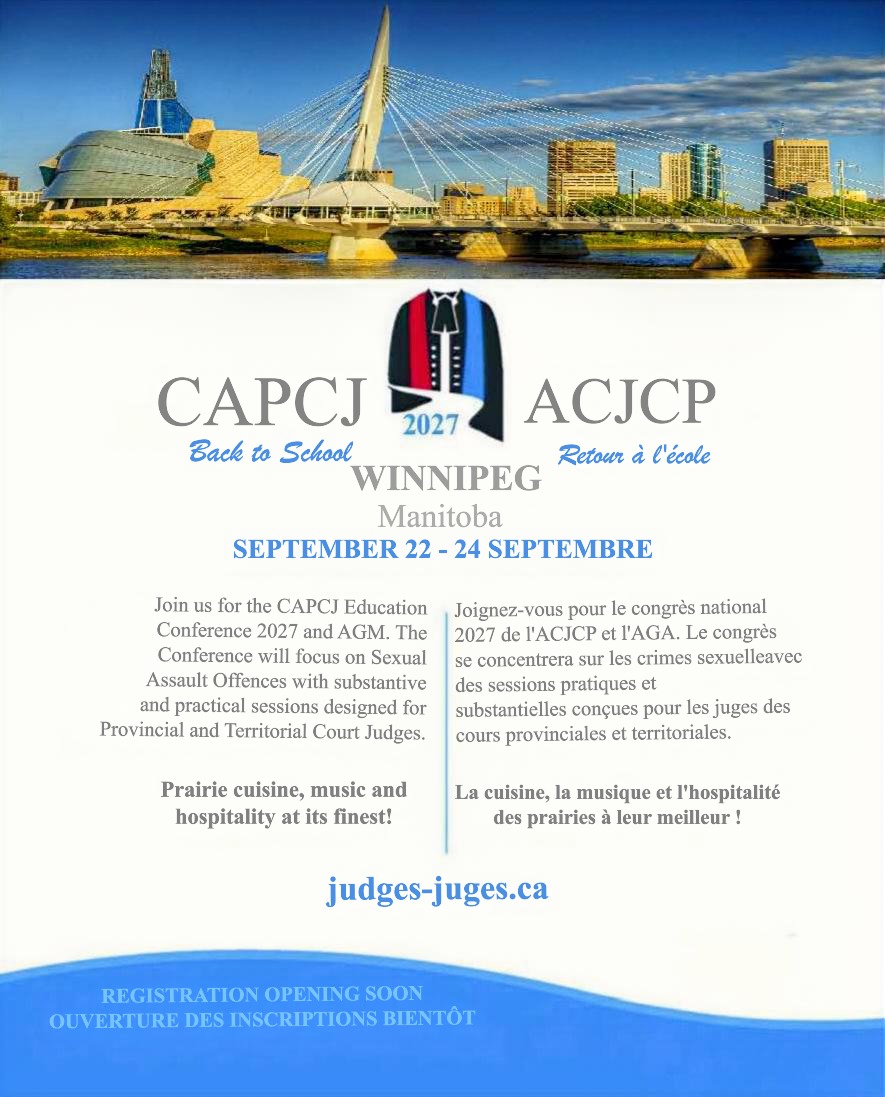
CAPCJ 2027 Educational Conference and AGA will take place September 22-24, 2027 at The Fort Garry Hotel
Click here to register for the event.
Itinerary
Registration: Wednesday September 22, 2027
2:00 p.m. - 6:00
Registration will be open on the Mezzanine level of the Fort Garry Hotel
Opening Ceremony: Wednesday September 22, 2027
7:00 p.m. - 10:00 p.m.
Opening Ceremony will take place at the Manitoba Museum of Human Rights
Hospitality Suite: Wednesday September 22, 2027
9:30 p.m. - 1:00 a.m.
The Hospitality Suite will be located in the Starlight Room of The Fort Garry Hotel
Registration: Thursday September 23, 2027
8:00 a.m. - 12:00 p.m.
Registration will continue to be available in the Mezzanine level of The Fort Garry Hotel
Breakfast: Thursday September 23, 2027
8:00 a.m. - 9:00 a.m.
Breakfast will be served at the Centre-East Hall of The Fort Garry Hotel
Opening Remarks: Thursday September 23, 2027
9:00 a.m. - 9:10 a.m.
Sponsors


Speakers
-

Jennifer Landhuis (M.S.) brings over 25 years of experience as an educator and advocate on the issues of stalking, domestic violence, and sexual assault to her current position as the Director of the Stalking Prevention, Awareness, and Resource Center (SPARC). As Director, she oversees the development and implementation of multi-faceted resources, programs, and publications on stalking, collaborates with national partners, and provides robust trainings to criminal justice and victim service professionals. Jennifer has led the SPARC initiative since its founding at AEquitas in 2017.
-

Professor Shaffer joined the Faculty of Law in 1990 after serving as a law clerk to Chief Justice Brian Dickson at the Supreme Court of Canada. She holds law degrees from Harvard and U of T. Professor Shaffer teaches Criminal Law, Evidence Law and Legal Methods, and has taught Family Law as well as courses on cultural diversity and gender issues.
-

Professor Peter Sankoff is an award-winning educator and researcher who focuses his work upon legal issues surrounding the criminal trial process and the relationship between animals and the law. He authors, co-authors or co-edits leading texts on the law of evidence (The Law of Witnesses and Evidence in Canada; the Portable Guide to Witnesses), criminal law (Manning, Mewett and Sankoff on Criminal Law, 5th ed.), legal writing (Professor Sankoff’s Guide to Persuasive Legal Writing) and animals and the law (Canadian Perspectives on Animals and the Law; Animal Law in Australasia: Continuing the Dialogue).
Peter graduated with a JD from the University of Toronto, and subsequently worked as a law clerk for Madame Justice Claire L’Heureux-Dubé at the Supreme Court of Canada. After pursuing an LL.M. from Osgoode Hall (York University), he joined the federal Department of Justice where he worked an advisor on human rights matters involving criminal justice. Peter then left Canada to teach as a Lecturer, and subsequently a Senior Lecturer, at the University of Auckland (New Zealand) from 2001-2011, before returning to the University of Alberta in 2012.
Peter has won numerous awards and recognition for his work on teaching pedagogy, including the 2016 Brightspace Award for Innovation in Teaching from the Society of Teaching and Learning in Higher Education, and the 2014 Information Technology Innovation Award from the University of Alberta (awarded to the person at the University of Alberta who shows the most innovative use of technology in teaching or administration). He also won an Early Career Research Excellence Award from the University of Auckland in 2006.
Peter has taught as an invited visiting professor at the University of Ottawa (2004), Haifa University (Israel)(2008), the University of Melbourne(Australia)(2009) Lewis and Clark College of Law (Portland, Oregon)(2010), the University of Western Ontario (London, Ontario)(2011-2012), Niigata University (Japan)(2012) and the University of Auckland (2013).
His work has been published in a number of the world’s most distinguished journals, including: the Queen’s Law Journal, the University of British Columbia Law Review, the Criminal Law Quarterly, the Alberta Law Review, The New Zealand Law Review and the Animal Law Review.
Peter has a real interest in the University of Alberta Moot Program. He has been a coordinator of the Brimacombe Moot Competition for several years, and in 2018 he coached the University of Alberta to victory in the Gale Cup, Canada’s preeminent criminal law moot, which Alberta had last won in 2001. In 2019, his team won the Gale Cup again becoming the first repeat winner since 1982. As a result of this win, the team qualified for the Commonwealth Law Moot in Zambia, where it competed against seven other national champions. Alberta ended up winning the Commonwealth Moot, the first time the University has ever achieved this honour. In 2020, Peter’s final year of coaching, Alberta won the Gale Cup for an unprecedented third time in a row.
Peter also works as a lawyer and has his own law firm, Sankoff Criminal Law. He is also the owner and founder of Criminal Defence Essentials, an educational company for criminal defence lawyers.

-
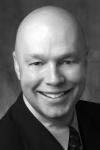
Raymond E. Wyant
The Honourable Raymond E. Wyant is a former Chief Judge of the Provincial Court of Manitoba.
He was appointed a Judge of the Provincial Court on May 20, 1998; appointed Chief Judge of the Provincial Court from July 10, 2002 to July 9, 2009; and designated a Senior Judge of the Provincial Court on September 16, 2014.
Raised in Saskatchewan, Wyant left his home province and obtained his law degree in Manitoba where he built his impressive and prestigious career.
Wyant, a Queen Elizabeth ll Golden Jubilee Recipient in 2002, has worked tirelessly for his adopted province of Manitoba in a professional capacity, but also as a volunteer for his community, including serving on community boards and coaching youth sports for more than 20 years.
He was an elected school trustee, chaired the Board of Regents at the University of Winnipeg and chaired the Community Notification Advisory Committee, among other community endeavours.
He has served in many professional capacities including having chaired both the National Steering Committee on Justice Efficiencies and Access to the Justice System, and The National Symposium on Criminal Justice Reform. He has also served as the executive director of the Canadian Council of Chief Judges.Judge Wyant has been active in continuing education across Canada and has taught for many years at the University of Manitoba Law School, Robson Hall.
He has consulted on a variety of projects including working for the United Nations in Africa. He also sat as a Deputy Judge in Yukon Territory.
Wyant was recognized in 2005 with a Gold Award for Innovation from the Institute of Public Administration of Canada (IPAC) and, in 2006, with a United Nations Public Service Award for leading an innovative coordinated approach to processing domestic violence cases that earned national and international recognition.
Judge Wyant has also been honoured as a Jurist of Robson Hall and as a Fellow of the University of Winnipeg.